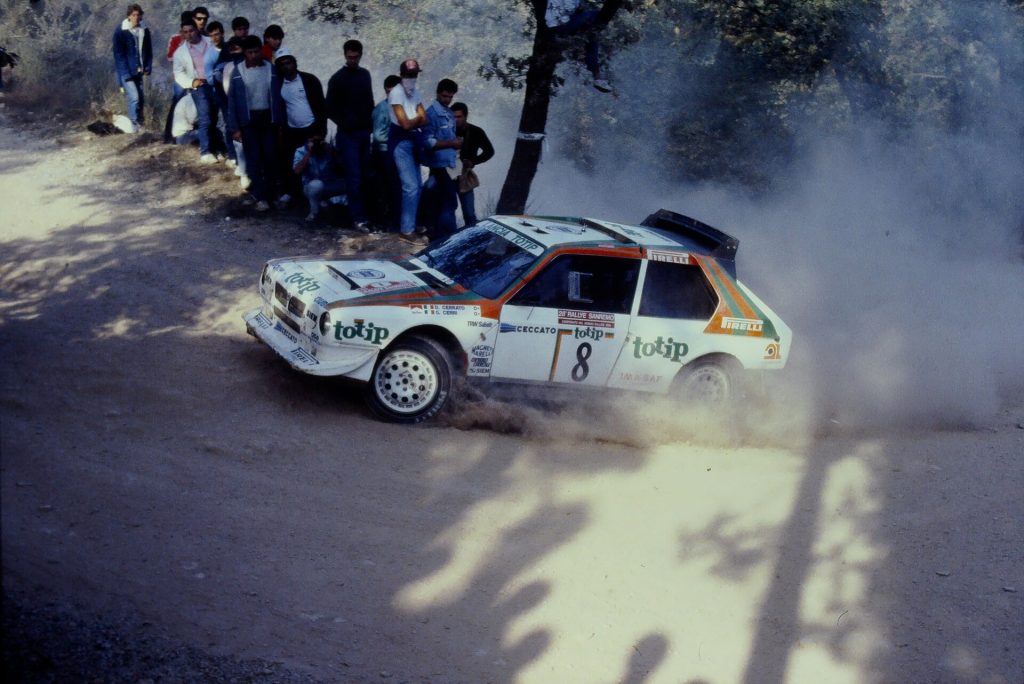
Ask longtime fans to name the most spectacular era in rallying and most will give the same answer: Group B. For a few years in the 1980s, rallying’s top category allowed cars with enormous power, very low weight and technology borrowed from aerospace and Formula 1. The cars were extraordinary, the crowds were enormous, and the era ended abruptly. Here is how Group B came about, what made it special and why it was shut down.
A new set of rules
Group B was introduced by motorsport’s governing body for the 1982 season as part of a reorganization of car categories. Compared with the production-based classes, Group B rules were relatively permissive. Manufacturers only had to build a small number of road-going versions, 200 units, to homologate a car. They could then build a smaller run of “evolution” versions to update it.
That relatively low production requirement let manufacturers design purpose-built competition cars with only a loose connection to anything you could buy in a showroom. Weight limits were tied to engine size, and turbocharging was allowed with an equivalence factor. The result was a category where engineers had far more freedom than in most of motorsport.
The cars
The early years of Group B were shaped by the Audi Quattro, which had already shown in the preceding seasons what four-wheel drive could do on loose surfaces. Lancia answered with the rear-wheel-drive 037, a lightweight mid-engined car that won the manufacturers’ title in 1983, the last time a two-wheel-drive car would do so for many years.
From there the cars became more extreme. Peugeot’s 205 Turbo 16 combined a mid-mounted turbocharged engine with four-wheel drive in a compact body that only resembled the road-going 205 hatchback. It won the titles in 1985 and 1986. Lancia’s Delta S4 used both a supercharger and a turbocharger to deliver power across the rev range. Ford built the RS200 and MG produced the Metro 6R4, both mid-engined and four-wheel drive. Power figures quoted for the most developed cars commonly ran to well over 400 horsepower, in cars that weighed little more than a family hatchback.
Engineering without a safety net
Much of the drama came from how quickly the technology moved. Teams used lightweight composite body panels, tubular spaceframe chassis and large aerodynamic wings, along with turbocharged engines that delivered their power in violent surges. Four-wheel-drive systems with adjustable torque split became more sophisticated each season. Safety did not keep pace in the same way. Fuel tanks, roll cages and crash protection were far less advanced than today’s standards, and when a car crashed at high speed, there was little to protect the crew. Engineers have since said that the cars outgrew the roads they were racing on, especially on narrow, tree-lined stages with no run-off.
The drivers
The era produced a generation of stars. Hannu Mikkola won the 1983 drivers’ title for Audi and Stig Blomqvist took it in 1984. Timo Salonen won with Peugeot in 1985 and Juha Kankkunen in 1986. Walter Röhrl, already a champion, Michèle Mouton, Markku Alén, Ari Vatanen and Henri Toivonen became household names among rally fans across Europe.
The crowds
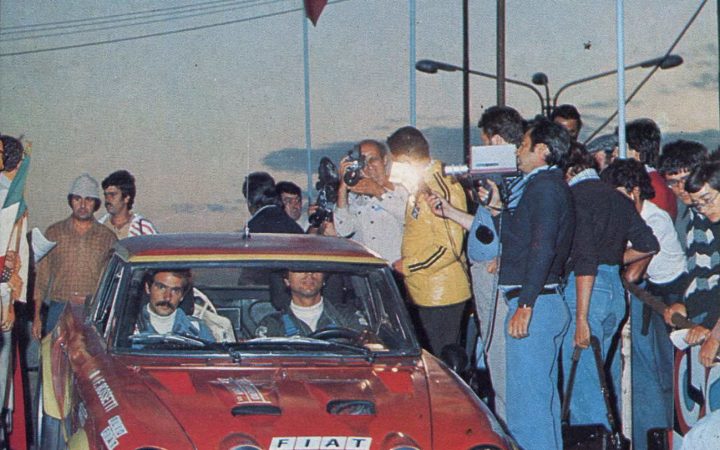
Group B coincided with a surge in popularity. Spectators turned up in vast numbers, especially in Portugal, Italy and Finland. Crowd control on many events was minimal by today’s standards. Fans lined the roads and stepped into the path of cars, parting only at the last moment. Photographs from the period show cars passing within inches of spectators.
Tragedy and the end of the era
The combination of rapidly increasing speed and weak crowd safety produced a series of serious accidents. In 1986 at Rally de Portugal, a Ford RS200 left the road and struck spectators, killing several people and injuring many more. The leading factory teams withdrew from the rest of that event.
Just weeks later, at the Tour de Corse, Henri Toivonen and his co-driver Sergio Cresto were killed when their Lancia Delta S4 left the road and caught fire. Toivonen was one of the fastest drivers of his generation and was leading the rally. The accident came only a short time after the Portugal tragedy, and the governing body announced soon afterwards that Group B would not continue as the top category. Group B ended as a world championship category after the 1986 season, and the planned Group S successor category was also cancelled.
What came next
From 1987 the World Rally Championship was contested under Group A rules, which required much higher production numbers and kept the cars closer to their road-going versions. Lancia adapted quickly with the Delta HF 4WD and later the Delta Integrale, which dominated the following years. Later the World Rally Car rules of 1997 gave manufacturers some extra freedom, but nothing approaching Group B.
Group B’s legacy
Group B’s influence went well beyond its few short seasons. It confirmed four-wheel drive as essential for the top level of rallying. It also pushed organizers to rethink spectator safety, which led to the designated spectator zones, marshals and safety plans that are standard today.
The cars live on. Several Group B machines went on to compete in rallycross, which gave the category a second life, while others now appear at historic events, hill climbs and festivals where fans can see and hear them run again. For many people, those cars still represent the high point of rally engineering, along with a reminder of how high the price of speed can be.