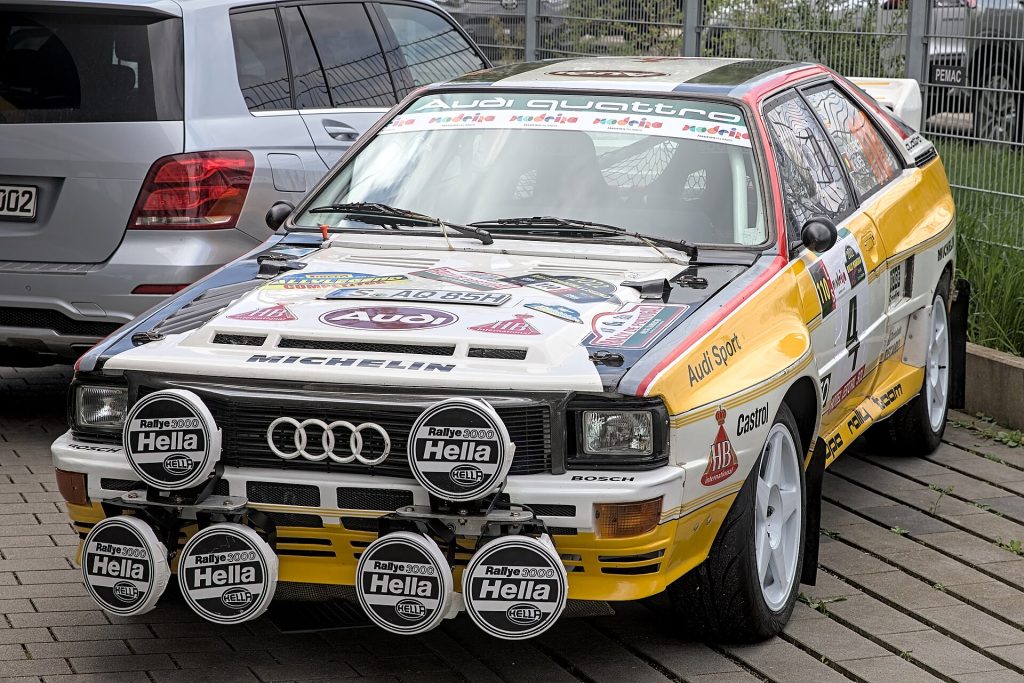
Today it is hard to imagine a top-level rally car that is not four-wheel drive. But at the start of the 1980s, the conventional wisdom in rallying was that four-wheel drive was too heavy, too complicated and too awkward for competition. The Audi Quattro changed that view in a remarkably short time. Its impact was so complete that within a few seasons every serious contender had to follow.
Origins of the Quattro
The Quattro grew out of a simple observation by Audi engineers in the late 1970s. During testing in winter conditions, a four-wheel-drive military vehicle, the Volkswagen Iltis, proved impressively capable on snow and ice despite its modest power. The engineers wondered what would happen if that kind of traction was combined with a powerful, turbocharged road car.
The result was the Audi Quattro, shown to the public at the Geneva Motor Show in 1980. It combined a turbocharged five-cylinder engine with permanent four-wheel drive in a coupe body. Unlike many earlier four-wheel-drive systems, it was designed for a fast road car rather than an off-roader, using a compact center differential to let the front and rear axles turn at different speeds.
Arrival in the World Rally Championship
Audi entered the World Rally Championship with the Quattro in 1981. The car’s speed on loose and slippery surfaces was obvious from the start. On snow, gravel and wet tarmac it could put power down out of corners in a way that rear-wheel-drive rivals simply could not match.
The early car was not perfect. It was heavy and suffered reliability problems, and its long nose made it less agile than some competitors on twisty tarmac. But its traction advantage was large enough to win events, and the team learned quickly.
The first major win came quickly. Hannu Mikkola took the Quattro to victory at the 1981 Swedish Rally, a snow event where its traction advantage was especially clear, and the result convinced many observers that four-wheel drive was here to stay. Rival engineers who had dismissed the idea began studying how they could build their own systems.
Michèle Mouton’s breakthrough
One of the most significant results of the Quattro’s first season came at the 1981 Sanremo Rally in Italy, where Michèle Mouton and her co-driver Fabrizia Pons won. It was the first time a woman had won a round of the World Rally Championship. Mouton followed it with three more wins in 1982 and finished second in the drivers’ championship that year, a result that remains one of the sport’s most impressive.
Championships
Audi won the manufacturers’ championship in 1982. Hannu Mikkola took the drivers’ title in 1983, and in 1984 Audi won both championships, with Stig Blomqvist as drivers’ champion. The car evolved throughout this period, moving into the new Group B category and culminating in the short-wheelbase Sport Quattro, which was more compact and more powerful.
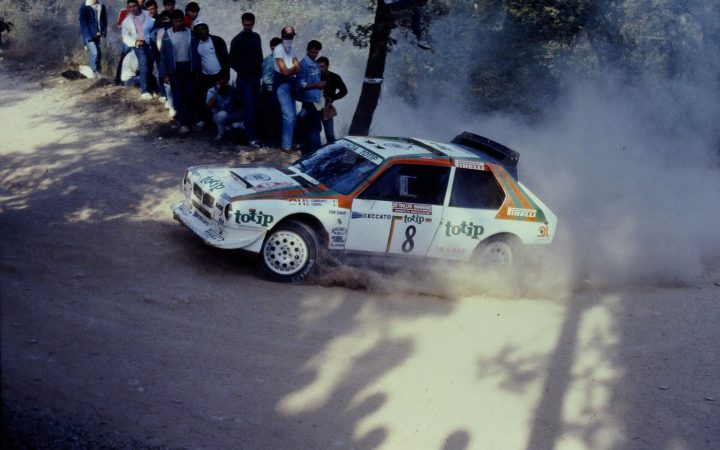
By the middle of the decade, however, rivals had learned the lesson and gone further. Peugeot’s 205 Turbo 16 and Lancia’s Delta S4 put the engine in the middle of the car and combined it with four-wheel drive, giving better balance than the front-heavy Audi. The Quattro’s era at the very top was brief, but it had already transformed the sport.
Why four-wheel drive works on rally stages
The advantage of four-wheel drive comes down to traction. On a loose or slippery surface, a car that sends all its power through two wheels will spin those wheels more easily, especially when accelerating out of slow corners. Sending power to all four wheels spreads the load across four contact patches, so more of the engine’s output turns into forward motion. On gravel, snow and ice, that can mean large time gains on every corner exit.
Four-wheel drive also changed driving technique. Drivers learned to use the throttle to stabilize the car through corners, and techniques such as left-foot braking became more widespread as drivers searched for ways to balance a car that pulled at both ends.
There were trade-offs. Early four-wheel-drive systems added weight and tended to make cars understeer, especially on tarmac. Teams spent years refining differentials, torque split and suspension geometry to make the cars turn as well as they gripped. The lessons from that development work fed directly into every competitive rally car that followed.
Legacy beyond rallying
The Quattro’s influence spread well beyond rally stages. Audi built its road car identity around the “quattro” name and four-wheel drive became a central selling point for the brand. Other manufacturers launched their own performance four-wheel-drive cars in the following decades, and many of the most famous rally road cars, from the Lancia Delta Integrale to the Subaru Impreza and the Mitsubishi Lancer Evolution, followed the path the Quattro opened.
The Quattro also had a famous life at the Pikes Peak International Hill Climb in Colorado, where Audi drivers won several times in the 1980s, including Michèle Mouton’s victory in 1985.
Remembering the Quattro
Original rally Quattros are now valued historic machines and regular attractions at festivals and historic rallies. Their distinctive sound, from the five-cylinder engine and turbocharger, is instantly recognizable to fans. More than four decades after it arrived, the Quattro is still remembered as the car that showed rallying how to use four driven wheels, and the sport was never the same afterwards.