
 John N

Behind-The Scenes Facts Every F1 Fan Should Know
Below are 20 behind-the-scenes facts about Formula One that every fan should know. You will undoubtedly find them interesting, particularly if you are a hardcore F1 follower. So go ahead and dive into the article to enlighten you with some of the most amazing F1 facts.
- F1 Cars can be driven upside down.
The principles of physics and aerodynamics are the core of a formula 1 car. The engine which is a 1.4 liter V6 can produce a massive 760 horsepower. This amount of energy on a 640kg car means that it could fly off from the tracks the moment the accelerator is pressed.
The presence of the large wings on the back and the fin at the front is to avoid such occurrence. Other than that the entire body of an F1 car is designed to be as aerodynamic as possible. aerodynamic devices on these cars create pressure differentials (basically different pressures) along the car and this results in something called downforce which pushes these cars onto the track.
The more downforce you have the further you squash the tyres into the track and the faster you can take a corner. When driving, the car exerts a downward force of about 4 tonnes, which means that it can be driven upside down.

- The engine is only a 1.4 liter V6.
Evolution in technology has brought about the change from the bigger V10 engines to the smaller and more efficient V6 engine. It produces an impressive 600 horsepower with an engine recovery that uses heat from the brakes and the exhaust to produce an additional 160 horsepower, giving a total of 760 horsepower.
- Braking exerts G-Forces greater than shuttle takeoff.
During a space launch, the crew would usually experience a maximum of 3 Gs force, but the Formula driver experiences a G force of about 5 Gs which is greater.
- Rescue response time is only 30 seconds.
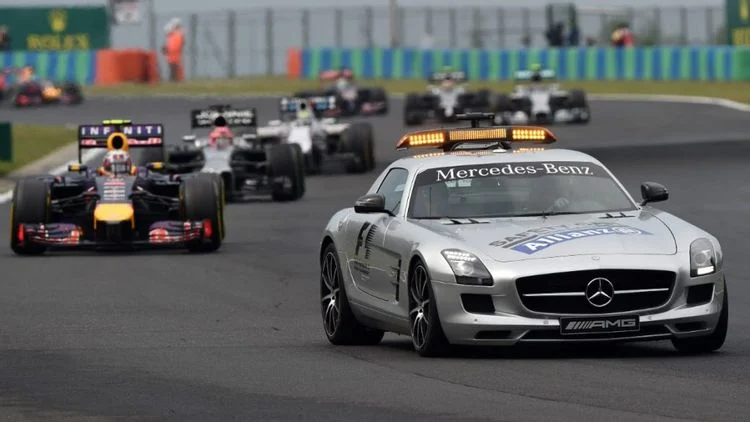
With cars traveling at high speeds, there’s bound to be a crash. Sometimes, it is impossible for the driver to get out of the wreckage. To take care of emergencies, there are a total of six rescue cars(four salvage cars and two rescue cars) waiting to be dispatched. They’re positioned such that it takes 30 seconds to get to the crash site.
- Both men and women can race.
F1 is a sport open to both genders even though it appears that it is male dominated at the moment. However, the selection criteria is rigid,hence the seemingly lack of female drivers.
- Every driver has a water bottle inside the cockpit.
The stress of driving so many laps around the circuit takes a toll on the driver’s body. Temperatures could reach extremely hot conditions of about 50oC causing the driver to lose bodily floods. Such loss impairs the psycho-physical abilities of the drivers which makes it imperative that they have a liter of water in their cockpits with a small pipe that goes into the driver’s helmet, allowing them to replenish lost fluids.

- F1 tires are inflated with nitrogen.
While the tires of our everyday cars are filled with air, the tires of F1 cars are filled with nitrogen. Why? Nitrogen offers a more consistent pressure when compared to normal air. This helps tires last a bit longer during the race.
- Driver’s equipment is fire resistant.
Crashes occur throughout the F1 season which sometimes leads to a fire outbreak, which is why there are several safety measures that have been put in place. One of these is the helmet that can take temperatures of about 800oC, while the Nomex suits can survive being exposed to temperatures of about 840oC for about 11 seconds. Drivers can also cut off all electric power in case of a crash.
- Drain covers are welded shut.
Due to the low-pressure generated underneath an F1 Car there’s the tendency for things to fly out thereby causing damage. Hence, the reason why manhole covers, which weigh about 50 kg, can fly right off causing damage to the car coming behind.

- 80,000 components make an F1 car.
The main goal is to reduce weight while boosting performance and efficiency at the same time. An F1 car weighs less than a Mini Cooper, but still it’s made up of 80,000 different components of which 16,000 are individual parts. An F1 car is an extremely compressed cocktail of hydraulic systems, carbon, fuel, tyres, inertia and mechanical devices. The suspension is made up of special carbon fiber and Kevlar alloy which allows it to handle stress around the track.


