 John N


Formula 1 is a high end racing competition. A car may look amazing and faster but it’s of no use if it is not taking corners perfectly. A fast car can succeed in turning around the corners and winning a race, but this is too hard to achieve all by itself. This is the reason why even an F1 driver team spends so much time practicing.
The corner is one of the most important parts of any circuit. It’s where speed can be lost or gained, and it sets the tone for the next straight. The corner determines whether a driver can drive through it flat-out or brake heavily to navigate the bend safely. Depending on the track, corners are varied in shape and severity. However, what happens at one corner can set the scene for another corner further down the circuit.
Drivers slow down, turn in later, and apex later as they approach a corner that leads onto a straight section of road. This gives them a straighter exit onto the straight, allowing them to accelerate sooner and more completely.

Types of corners
When you look at any racetrack, you’ll notice that it has a few long parts of the track, commonly referred to as “straightaways.” The “straightaways” are followed by a series of corners that would challenge a driver’s racing line. Corners come in lots of different shapes—some are wide and some are narrow. But because every turn on a track is different, we can categorize all turns into three major types.
- Corner ahead of a long straight
When a car moves in a straight line, it is at its fastest. That does not mean that cars should always be driven straight or from point A to B.
However, when a corner is ahead of a long straight, drivers try to open the corner exits as far as possible to improve lap times. Exiting these corners with a little more speed will create additional momentum further down the straight. In turn, this results in time-saving on each lap.
It is advantageous for drivers to brake in a little earlier, start to turn in a little bit later, take the apex later, and open up the exit of the corner to allow for better acceleration down the straight.C
- Corner ahead of a short straight
A short straight can be defined as a link between two corners without any time for an extended period of acceleration or overtaking. In this type of corner, the opportunity to gain time is on the entry to the corner and the exit of the upcoming corner, depending on the length of the following straight.
- Directly ahead of another corner, or series of corners
A series of corners is probably the most exciting on a racetrack. They can also prove to be a little challenging for a driver. When a driver gets these corners right, they can also be a little rewarding. When one corner precedes another, the exit of one corner becomes the entry into the next corner. So, how do drivers decide which is the most crucial racing line to take?
The corner which precedes the upcoming long straight is always the most crucial, and any additional speed on the exit here will be carried down the straight, making for a faster lap time. When we think about the racing line, we should work from the final corner in the sequence before the next straight. Drivers aim for a late apex to get up to speed as early as possible on the exit, maximizing the speed down the next straight. This strategy aims to maintain a high momentum and position the car ideally for the final corner in the series.
In a series of corners, it becomes relevant to be dynamic. If a driver runs a little wider on the exit of turn one, he would have won a little extra time, but they would have also compromised their entry into the next corner.
F1 cars are very fast in corners. Their speed is due to a number of factors, including:
- Race Tracks
A racetrack is made of corners and straightaways. Some corners are faster than others, and some have more turns than others. The different types of corners are what determine how fast a race car can go through the corners, which in turn determines the overall lap time.
- Grip
When a driver approaches a corner, whether it is a fast corner or a slow one, the driver’s ability to go fast depends on how much grip his car has. The “grip” on an F1 car determines how it sticks onto a track and how fast it can go without losing control and spinning off the track.
- Tyres
When it comes to racing, the tires are what provide traction to the car. The tires are a key component of vehicle performance. As such, they are considered an integral part of the vehicle’s design and construction. To maximize the car’s grip and performance on a racing track Formula 1 teams have a wide selection of tires to choose from, ranging from soft compound tires to medium and hard compound tires. They can also choose Intermediates and Wet weather tires on a wet racetrack. The choice of tire for F1 teams comes down to track surface temperature and the weather conditions on the qualifying session and race day. A soft compound tire would give a better grip going into and out of a corner, but it also degrades very quickly resulting in the tire being changed every 25 to 30 laps of a race. On the other hand, a harder compound tire does not have as good grip as a soft compound tire, but it does last longer than the soft compound tire. With a poor grip of the car to the track, the entry and exit into each corner can be drastically affected.
- Weight of the car
It’s easier for an F1 driver to control a light vehicle than a heavier one. The weight of the car can be affected by many things, including the amount of fuel it carries. A balanced weight distribution makes it easier for an F1 driver to maneuver around corners.
- Aerodynamics
To take corners, Formula 1 drivers rely on the vehicle’s aerodynamics. The aerodynamics of a Formula 1 car is composed of three basic elements: front wings and rear wings, which generate the majority of downforce for the car; and diffusers, which channel airflow around the car. A team can alter how a Formula 1 car’s aerodynamics works in order to optimize performance at different tracks. F1 teams can control the amount of downforce generated by the front wings and rear wings. Smaller or tighter tracks like Monaco require more downforce because there is not as much straightaway on these tracks. For drivers to better navigate a corner, they have to have optimum downforce so that the car does not spin out when turning through difficult corners.
Braking Zone
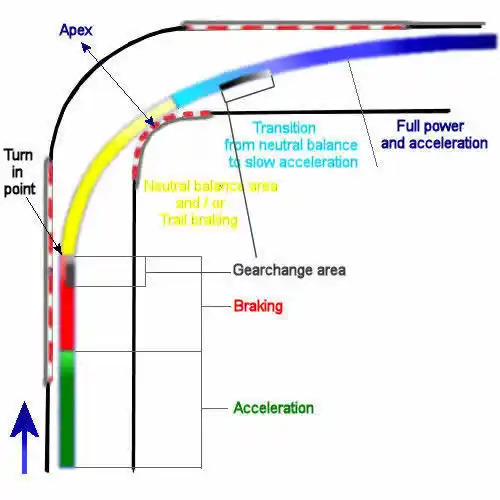
The braking zone is the phase of the race track when the driver must slow down from a fast speed to a low speed so he can drive through the turn. The braking zone in Formula 1 can be defined as the point of an F1 circuit where a driver needs to brake before entering into a corner to maximize his speed when exiting a corner.
When F1 drivers approach a corner, they need to brake quite hard. The biggest challenge for drivers is finding out the ideal point at which to begin braking. Braking too early or too late can be costly for a driver as he could either lose his place or cost him his lap time. In addition, if a driver brakes too late, he could find himself crashing into a barrier. To help drivers gauge their braking point easily, every racetrack has brake marker boards. These markings range between 200km/h to 50km/h, varying across tracks.
When drivers approach a corner, they aim to slow down gradually and exit the corner at a higher speed. Drivers begin braking about 100 meters before the corner and continue to brake for about 60 meters. They aim to hit a “sweet spot” by braking at exactly the right time, which allows them to accelerate out of the corner quickly. The more practice drivers get at using their brakes in this way, the better they become at maximizing their speed through corners.
In conclusion, the basis of F1 is a combination between handling and power as the biggest factor in how they take corners. One thing to note here is that each driver may use a slightly different technique depending on their car, and the particular corner. But this is a general outline on how to get the highest speed out of any corner.