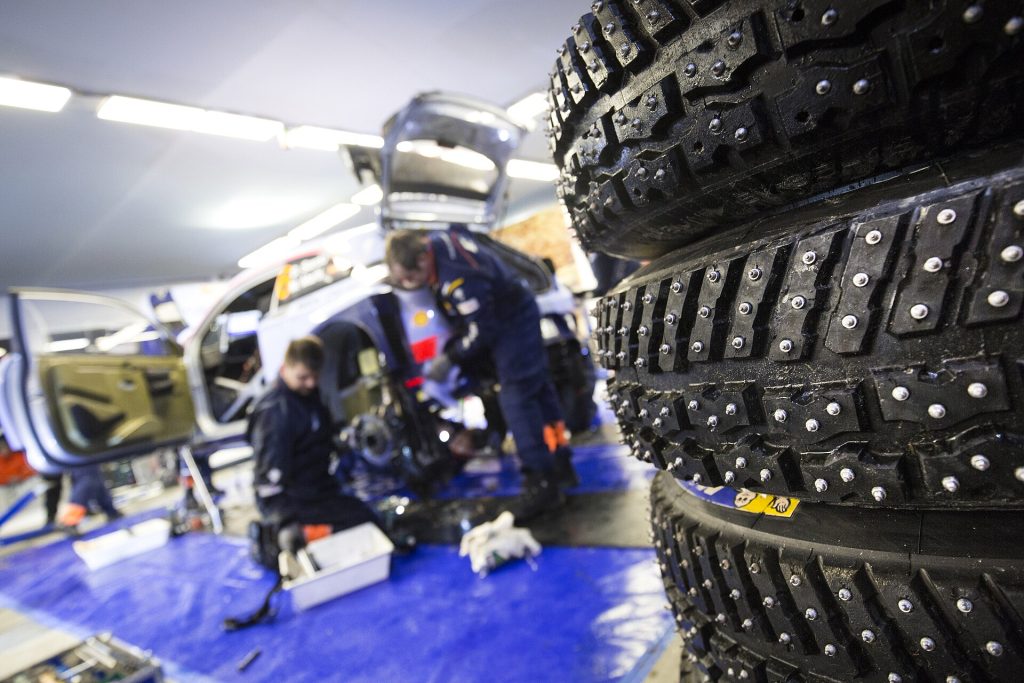
Ask a rally driver what matters most on a tricky stage and many will give the same answer: the tires. A rally car’s only contact with the road is four patches of rubber about the size of a hand, and those patches have to work on surfaces ranging from loose gravel to dry asphalt to sheet ice. Choosing, managing and conserving tires is one of the most important parts of rally strategy. This guide explains the basics.
Why rally tires are different
Circuit racing tires are designed for one surface: smooth, consistent asphalt. Rally tires have to deal with sharp stones, ruts, potholes, mud, frost and changing grip from one corner to the next. They also have to survive long stages, sometimes more than 20 miles, without a change. That means rally tires are built with tough sidewalls and carcasses designed to resist punctures and damage.
Many rally tires also have reinforcement or insert systems that allow a car to keep going for a while after a puncture, although driving on a damaged tire still costs a lot of time.
Gravel tires
Gravel tires have a deep, open tread pattern with large blocks. The tread lets the tire bite into loose surfaces and clear stones and mud. They are usually narrower and taller than tarmac tires and run on smaller wheels, typically 15 inches in diameter at the top level. That gives a taller sidewall that can absorb impacts from rocks and bumps.
Gravel tires usually come in harder and softer compounds. Harder compounds last longer and resist damage on abrasive, rocky stages and in hot weather. Softer compounds give more grip in cooler conditions or on smoother, softer roads but wear faster.
Tarmac tires
Tarmac tires look much more like road or circuit tires. They are wider and run on larger wheels, typically 18 inches at the top level, with a lower-profile sidewall. Dry tarmac tires have shallow grooves or none at all for maximum grip, while wet-weather tires have deeper grooves to clear water.
As with gravel, there are different compounds. A harder compound may be chosen for warm, abrasive roads, a softer one for cooler, damp conditions. Mixed-surface events like Rally Monte-Carlo can make choices extremely difficult, as a stage may switch from dry asphalt to ice in a few hundred yards.
Snow and ice tires
On events held on snow and ice, cars use narrow tires fitted with metal studs that dig into the frozen surface. Studded tires give astonishing grip on ice, allowing cars to reach high speeds on stages that would be nearly impossible to drive on normal tires. Regulations specify the number and length of the studs.
Some winter events also use unstudded winter tires or tires with fewer studs when conditions are mixed. The choice depends on how much ice, snow and bare road the crews expect to find.
The single-supplier system
The World Rally Championship uses a single tire supplier. Pirelli has held that role since 2021, supplying its Scorpion range for gravel, P Zero for tarmac and Sottozero for winter events. A single supplier keeps costs down and makes the competition fairer, since every crew uses the same tires. Many national championships also run with a control tire or limited tire choices.
Allocations and nominations
Teams do not get unlimited tires. At top level, each crew has a fixed allocation for each event, and rules control how many tires they can use and when. Teams must decide in advance how many tires of each compound to bring, and before each loop of stages they choose which tires to fit and how many spares to carry.
Most rally cars carry one or two spare wheels in the car. Carrying more spares adds safety against punctures but increases weight. Carrying fewer saves weight but raises the risk of being stranded or losing big time if a tire fails.
Managing tires during a stage
Good drivers do not just drive fast; they manage their tires. On a long gravel stage, a driver may avoid sliding the car too much to prevent overheating and wearing the rubber. On tarmac, overdriving in the early part of a stage can leave the tires overheated and slippery at the end. Teams look carefully at tire wear after each loop and adjust their plans.
Road position also affects tire choice. On gravel, early cars may face a loose surface layer, while later cars find a cleaner line but deeper ruts. On winter events, early cars sometimes clear snow from the road, revealing ice or gravel for those that follow.
Weather and timing
Weather forecasts play a major role in tire decisions. If rain is expected later in the day, a team may choose a softer compound or carry a wet tire. If it is set to warm up, harder compounds may be safer. Because cars often run two or three stages between tire changes, a wrong decision can cost a lot of time.
Why it matters to fans
Tire strategy explains much of what fans see in rally results. A driver who chooses the right tire for a changing stage can gain dramatic amounts of time, while a puncture or wrong compound can wreck a strong result. Watching which tires crews fit at service is one of the best ways to understand the story of a rally as it unfolds.