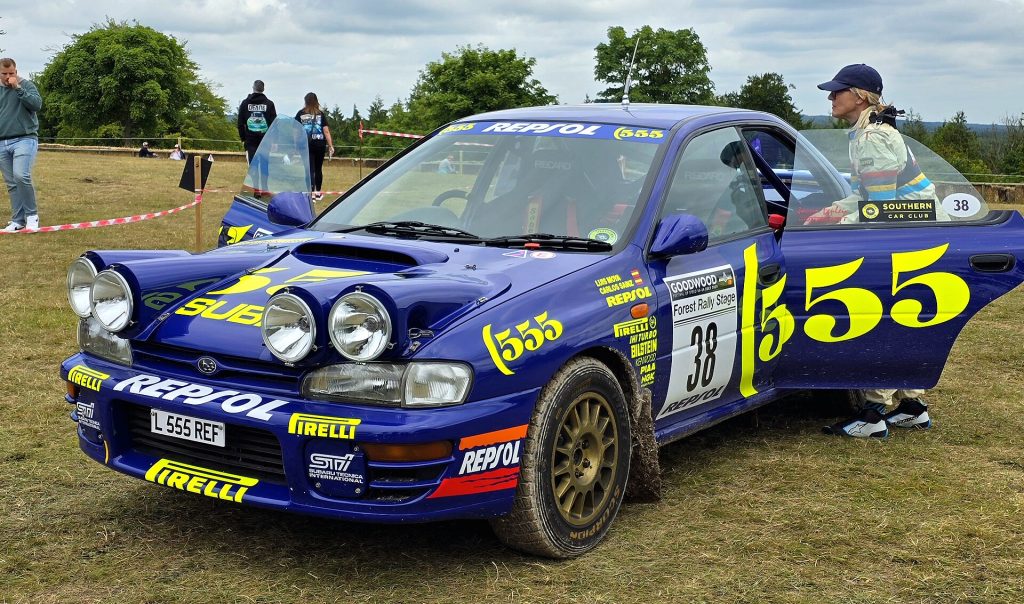
For a generation of fans, rallying means a blue Subaru Impreza with gold wheels, flat-four engine burbling, sliding through a forest. Subaru’s factory years in the World Rally Championship, run in partnership with the British engineering company Prodrive, produced three manufacturers’ titles, three drivers’ champions and a car that became a cultural icon well beyond the sport. Here is how that era unfolded.
A partnership with Prodrive
Subaru’s serious push into the World Rally Championship began at the start of the 1990s, when it teamed up with Prodrive, the company founded by David Richards in Banbury, England. Prodrive designed, built and ran the cars, while Subaru supplied the engineering base, the engines and the funding. The partnership lasted for nearly two decades.
The first car was the Legacy, a four-door sedan powered by a turbocharged flat-four engine with four-wheel drive. Subaru’s signature combination of a horizontally opposed engine and symmetrical all-wheel drive gave the car a low center of gravity and good balance. The Legacy delivered Subaru’s first World Rally Championship win at Rally New Zealand in 1993 with a young Scottish driver named Colin McRae.
Enter the Impreza
Later in 1993, the Legacy was replaced by the smaller, lighter Impreza. The Impreza suited rallying perfectly: compact, agile and strong, with the same flat-four and all-wheel-drive layout. Its distinctive livery, sponsored by a tobacco brand at the time, became one of the most recognizable in motorsport.
Colin McRae and the 1995 title
McRae was famous for an all-or-nothing style. He was spectacular, brave and sometimes prone to mistakes, and fans adored him. In 1995 everything came together. McRae won the drivers’ world championship with co-driver Derek Ringer, becoming the first British driver to win the world title and, at the time, its youngest champion. Subaru also took the manufacturers’ championship that season.
Subaru went on to win the manufacturers’ title again in 1996 and 1997, a three-year run that confirmed the Impreza as the dominant car of the mid-1990s.
The World Rally Car era
In 1997 the championship introduced World Rally Car regulations, which gave manufacturers more freedom to modify production cars for competition. Prodrive responded with the Impreza WRC, based on the two-door coupe body. It won on its debut and helped Subaru secure its third consecutive manufacturers’ crown that year.
Alongside the factory cars, Subaru sold road versions of the Impreza, including the WRX and STI models, which helped create a huge following among enthusiasts worldwide. For many fans, owning an Impreza was a way to get closer to the cars they watched on television and in video games.
Richard Burns and Petter Solberg
After McRae left for Ford at the end of 1998, Subaru continued to win titles with new stars. Englishman Richard Burns, partnered by Robert Reid, won the drivers’ championship in 2001. Two years later, Norwegian Petter Solberg, partnered by Phil Mills, took the 2003 title. Solberg, known for his enthusiasm and his energetic style, became one of the most popular drivers of the era.
What made the Impreza so effective
Engineers and drivers often point to a few qualities that made the Impreza so successful. The flat-four engine sat low in the chassis, which helped the car change direction quickly. The all-wheel-drive layout was balanced from side to side, and Prodrive’s suspension work made the car strong enough to survive the roughest gravel events. The team was also known for its fast, well-organized service crews, which could rebuild a damaged car in the short windows allowed between stages.
Changing fortunes
The mid-2000s were tougher. Rivals such as Citroën, with Sébastien Loeb, and Ford raised the level of competition significantly. Subaru continued to win rallies, but the titles became harder to come by. In 2008 the team introduced a new hatchback-based Impreza WRC, but it did not restore the team to the top.
At the end of 2008, Subaru announced its withdrawal from the World Rally Championship, citing the economic conditions of the time. It brought the factory program to a close after almost twenty years.
Subaru in American rallying
Subaru’s rally story did not end with its WRC exit. In the United States, Subaru Motorsports USA, supported by Vermont SportsCar, has been a long-standing presence in American rallying and rallycross. Drivers such as Travis Pastrana and David Higgins have won national rally titles in Subaru machinery, and the cars remain popular with privateers across North America.
The legacy
Subaru’s years in the World Rally Championship left a deep mark. The cars won on gravel, tarmac and snow across the world and showed that a relatively small manufacturer could compete with the industry’s biggest names. Colin McRae, who died in 2007 in a helicopter accident, remains one of the most celebrated drivers in rally history, and the blue Impreza remains a symbol of his era.
The Impreza also helped bring rallying to a broader audience through its road cars and through the rally video games named after McRae. Ask any fan who grew up in the late 1990s what got them interested in rallying, and there is a good chance the answer involves a blue car with gold wheels.