
 John N


Ahead of an expected upgrade package for the Ferrari F1-75 at this weekend’s Spanish Grand Prix, Team Principal Mattia Binotto has said he is concerned by the pace of Red Bull’s development over the season. At the Miami Grand Prix, Binotto estimated that the RB18 had an advantage of around 0.2s per lap over the Ferrari F1-75.
He said, “I hope Red Bull will stop developing because there is a budget cap in Formula 1. I don’t know how they can do that. It will be our turn to develop our car in the following races by introducing updateS. We don’t have enough money to spend on upgrades.
Ahead of what Ferrari hopes will be upgrades that will neutralize those recent Red Bull gains, here we can summarise the changes which have made the RB18 such a formidable package, one in which Max Verstappen has won all three races in which he has finished.
Pre-season testing
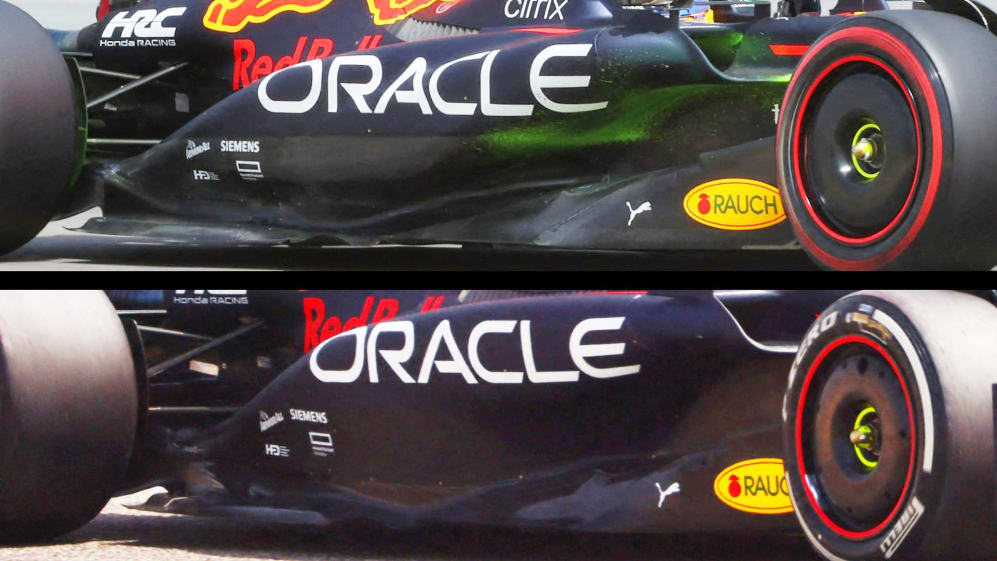
The biggest of the car’s upgrades came on the second day of Bahrain testing, with a reconfigured sidepod and floor.
The sidepod was more tightly packaged around the car’s cooling system, exposing more of the floor’s upper surface at the front and, in this way, allowing a more progressive outward sweep of the undercut there. There were accompanying changes along the floor edge, with a new ‘curl’ to induce a more powerful vortex along the edge of the floor.
It has been speculated that the underfloor ‘skate’ – a drilled metallic plate towards the rear of the floor which is believed to prevent the floor from becoming so close to the track that the underbody airflow stalls – first appeared with this update.
Jeddah
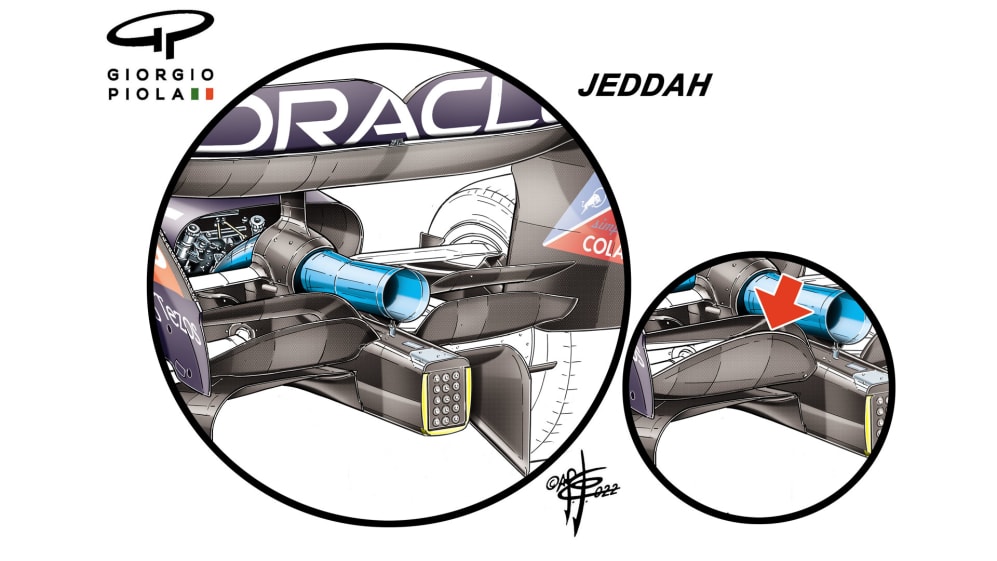
For the low-drag demands of the Saudi Arabian track, Red Bull had a different lower beam wing with reduced depth and an accompanying new rear wing endplate design. Ferrari, by contrast, remained with their standard rear wing but merely trimmed the flap area.
Melbourne
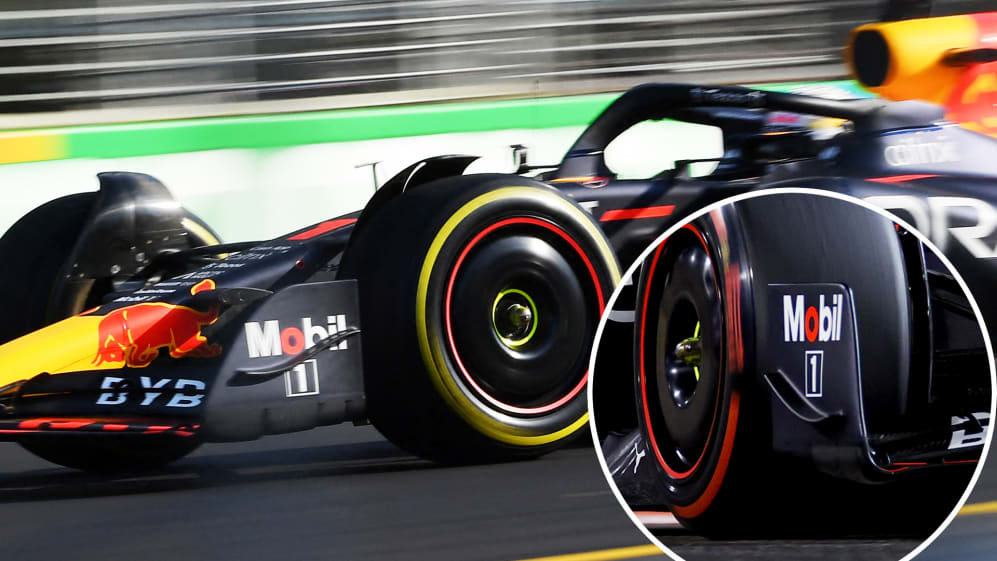
In Australia, Red Bull introduced new front wing endplates, with the front corner snipped diagonally and a new S-shaped dive plane on the outer wall. As well as tweaking the airflow, these changes brought a weight saving as Red Bull endeavored to reduce what was estimated to be a 10kg surplus over the minimum weight limit.
Imola
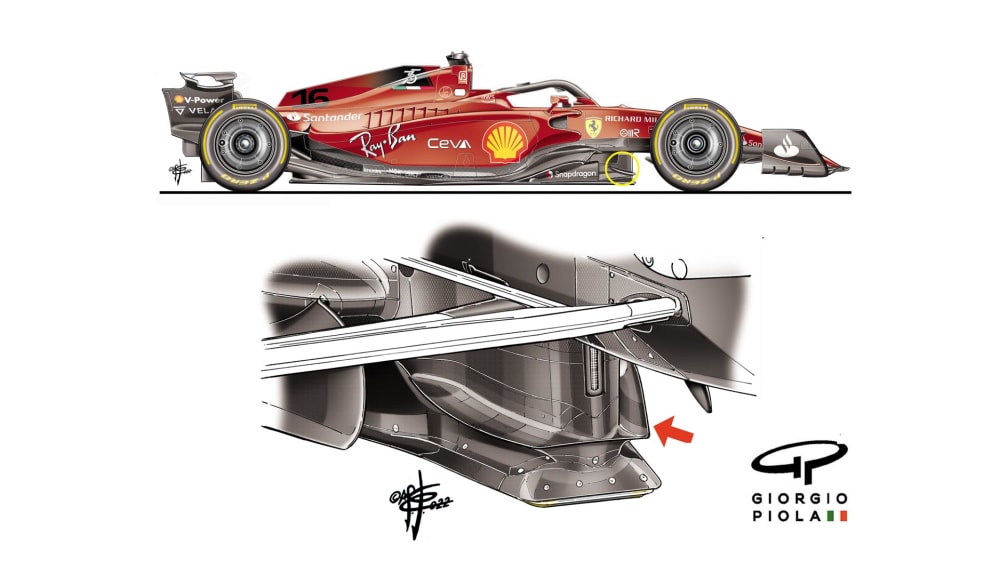
At the Italian track, Red Bull’s development continued apace. Further weight savings came from a new floor (of the same geometry as before but different carbon lay-up) and redesigned brake calipers.
Aerodynamically, a Ferrari-like winglet was added on the keel splitter at the floor’s leading edge. This will contribute directly to direct downforce on that part of the floor.
Miami
Although visually, there was no significant change at Miami, a further weight saving was made by hollowing out some components manufactured initially as solid because of time constraints.
As can be seen, Red Bull has brought performance parts to their car at every race so far, while the Ferrari has remained almost unchanged.
In Bahrain, for the opening race, the Ferrari was fast enough for Charles Leclerc to contain Verstappen’s challenge even before the Red Bull retired. By Miami, Verstappen overcame a troubled qualifying and to catch, pass and pull away from Leclerc. Verstappen led the Ferrari by a handy eight seconds on the eve of the first stops.
For this weekend, Ferrari hopes to reset the performance equation with a significant update package of their own while hoping Red Bull’s development program will suffer a budget-dictated loss of momentum.


